
Morse code is a method of encoding text using sequences of dots (dits) and dashes (dahs) to represent letters, numbers, and punctuation. Invented by Samuel Morse in the 1830s, this communication system remains relevant today for amateur radio operators, emergency signalling, and accessibility applications.
Read more:
If you’re just getting started, explore our Step-by-Step Morse Code Learning guide to build skills progressively and avoid common beginner mistakes.
This comprehensive guide covers everything from complete reference charts to proven learning methods that can help you master Morse code efficiently.
What is Morse Code?
Morse code transforms written language into a series of short signals (dots) and long signals (dashes) that can be transmitted through sound, light, or electrical pulses. Each letter and number has a unique pattern, making it possible to communicate across vast distances without voice transmission.
Modern applications include:
- Amateur (HAM) radio communication
- Emergency signalling (SOS: …—…)
- Aviation and maritime backup systems
- Accessibility tools for people with limited mobility
- Military and tactical communications
Morse Code Translators for Practice and Learning
Learning Morse code becomes much easier when you can instantly convert text into dots, dashes, sound, and visuals. Modern Morse code translators allow beginners and advanced learners to practice recognition, timing, and rhythm without specialised equipment.
A reliable Morse code translator lets you enter text and immediately see its Morse equivalent, making it ideal for checking accuracy and reinforcing patterns during daily practice. This is especially useful when learning new characters or reviewing common abbreviations.
For learners who benefit from visual reinforcement, a Morse code image translator displays dots and dashes in a clear, graphical format. Seeing the structure of characters alongside their text representation helps strengthen memory and pattern recognition, particularly for beginners.
Sound-based learning is essential for real proficiency. Using a Morse code audio translator allows you to hear correct timing, spacing, and rhythm, which is critical when practising methods like Koch or Farnsworth. Listening regularly helps train your ear to recognise characters as complete sound patterns instead of individual dits and dahs.
By combining text, image, and audio tools, you can create a balanced practice routine that accelerates learning and builds long-term fluency.
Complete Morse Code Alphabet Chart
Morse Code Letters (A-Z)
| Letter | Code | Letter | Code | Letter | Code |
|---|---|---|---|---|---|
| A | .- | J | .— | S | … |
| B | -… | K | -.- | T | – |
| C | -.-. | L | .-.. | U | ..- |
| D | -.. | M | — | V | …- |
| E | . | N | -. | W | .– |
| F | ..-. | O | — | X | -..- |
| G | –. | P | .–. | Y | -.– |
| H | …. | Q | –.- | Z | –.. |
| I | .. | R | .-. |
Morse Code Numbers (0-9)
| Number | Code | Number | Code |
|---|---|---|---|
| 1 | .—- | 6 | -…. |
| 2 | ..— | 7 | –… |
| 3 | …– | 8 | —.. |
| 4 | ….- | 9 | —-. |
| 5 | ….. | 0 | —– |
Morse Code Punctuation
| Symbol | Code | Symbol | Code |
|---|---|---|---|
| Period (.) | .-.-.- | Comma (,) | –..– |
| Question (?) | ..–.. | Exclamation (!) | -.-.– |
| Apostrophe (‘) | .—-. | Quotation (“) | .-..-. |
| Slash (/) | -..-. | Parenthesis ( | -.–. |
| Colon (:) | —… | Semicolon (;) | -.-.-. |
| Equals (=) | -…- | At sign (@) | .–.-. |
Morse Code Timing Rules
Understanding proper timing is essential for accurate Morse code transmission and reception.
| Element | Duration | Example |
|---|---|---|
| Dit (dot) | 1 unit | Base measurement |
| Dah (dash) | 3 units | Three times longer than dit |
| Intra-character space | 1 unit | Between dits/dahs in same letter |
| Inter-character space | 3 units | Between letters |
| Word space | 7 units | Between words |
For example, the letter “A” (.-) takes 5 units: dit (1) + space (1) + dah (3) = 5 units total.
Read more:
For quick lookup and offline practice, use our printable Morse code chart with letters, numbers, and punctuation in one place.
Best Methods to Learn Morse Code
Two scientifically-developed approaches dominate Morse code education. Both focus on learning by sound pattern recognition rather than visual memorisation of dots and dashes.
Koch Method
The Koch Method was developed by German psychologist Ludwig Koch in the 1930s. This technique has become the most widely recommended approach for building automatic character recognition.

How it works:
- Start with just two characters at full target speed (20+ WPM)
- Practice until you achieve 90% accuracy
- Add one new character
- Repeat until all characters are mastered
Why it works: By learning at full speed from the beginning, your brain develops automatic pattern recognition instead of consciously counting dits and dahs. This prevents the frustrating “speed plateau” that occurs when learners start slow and try to increase speed later.
Recommended settings:
- Character speed: 20-25 WPM minimum
- If you can count dits and dahs, increase to 25-30 WPM
Farnsworth Method
The Farnsworth Method was created by Donald R. “Russ” Farnsworth (F6TTB). This approach maintains full-speed character recognition while giving beginners more processing time.
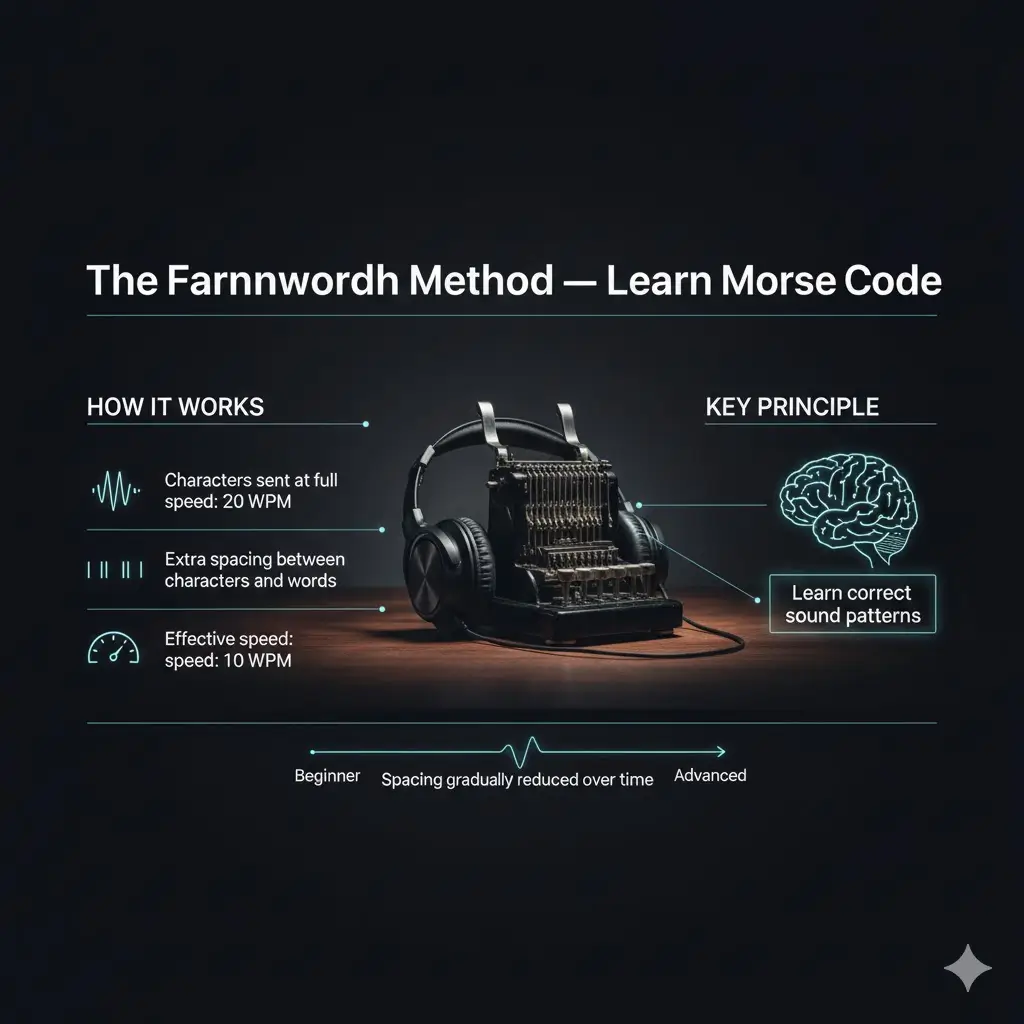
How it works:
- Characters are sent at full speed (typically 20 WPM)
- Extended spacing between characters and words (effective speed 10 WPM)
- Gradually reduce spacing as proficiency increases
Why it works: You learn the correct sound patterns immediately while having time to process what you heard. The extended spacing prevents you from repeating the sound pattern in your head.
Which Method Should You Choose?
| Factor | Koch Method | Farnsworth Method |
|---|---|---|
| Best for | Building automatic recognition | Beginners who need processing time |
| Starting characters | 2 letters | 2 letters |
| Character speed | 20+ WPM | 20 WPM |
| Spacing | Standard | Extended (reduces over time) |
| Accuracy threshold | 90% before adding letters | 70-90% before advancing |
Practical recommendation: Try both methods and see which works better for you. The most important factor is consistent daily practice, even if only 10 minutes per session.
Morse Code Memorisation Shortcuts
These pattern-based techniques can dramatically reduce memorisation time. Using these methods, only two characters (C and Z) require completely separate memorisation.
The Symmetry Method (Letter Pairs)
Many Morse code letters form symmetrical pairs—learn one, and you automatically know the other by reversing the pattern.
Mirror-image pairs:
| Pair | First Letter | Second Letter |
|---|---|---|
| A-N | .- | -. |
| D-U | -.. | ..- |
| G-W | –. | .– |
| B-V | -… | …- |
| F-L | ..-. | .-.. |
| Q-Y | –.- | -.– |
| K-R | -.- | .-. |
| X-P | -..- | .–. |
Once you memorise A (.-), you instantly know N (-.) by flipping the pattern.
Number Pattern System
All numbers use exactly five elements, following a logical pattern:
Numbers 1-5: Start with dots, fill remaining positions with dashes
- 1 = .—- (1 dot, 4 dashes)
- 2 = ..— (2 dots, 3 dashes)
- 3 = …– (3 dots, 2 dashes)
- 4 = ….- (4 dots, 1 dash)
- 5 = ….. (5 dots)
Numbers 6-9: Subtract 5, start with that many dashes, fill with dots
- 6 = -…. (6-5=1 dash, 4 dots)
- 7 = –… (7-5=2 dashes, 3 dots)
- 8 = —.. (8-5=3 dashes, 2 dots)
- 9 = —-. (9-5=4 dashes, 1 dot)
Zero: Simply memorise as —– (5 dashes)
Dot-Only and Dash-Only Letters
These characters use only one element type, making them easy anchor points:
Dots only:
| Letter | Code | Pattern |
|---|---|---|
| E | . | 1 dot |
| I | .. | 2 dots |
| S | … | 3 dots |
| H | …. | 4 dots |
Dashes only:
| Letter | Code | Pattern |
|---|---|---|
| T | – | 1 dash |
| M | — | 2 dashes |
| O | — | 3 dashes |
Mnemonic Sentences
Create word associations where syllable emphasis matches the dit-dah pattern. Stressed syllables represent dashes (DAH), unstressed represent dots (dit).
| Letter | Code | Mnemonic | Rhythm |
|---|---|---|---|
| A | .- | a-BOUT | dit-DAH |
| B | -… | BOOT-it-up-now | DAH-dit-dit-dit |
| C | -.-. | CO-ca-CO-la | DAH-dit-DAH-dit |
| G | –. | GOOD-GRAV-y | DAH-DAH-dit |
| J | .— | ja-PAN-ESE-GIRLS | dit-DAH-DAH-DAH |
| K | -.- | KAN-ga-ROO | DAH-dit-DAH |
| L | .-.. | a-LAD-in-sane | dit-DAH-dit-dit |
| M | — | MA-MA | DAH-DAH |
| O | — | OH-MY-GOD | DAH-DAH-DAH |
| Q | –.- | GOD-SAVE-the-QUEEN | DAH-DAH-dit-DAH |
| R | .-. | a-RO-se | dit-DAH-dit |
| V | …- | Bee-tho-ven’s FIFTH | dit-dit-dit-DAH |
| W | .– | a-WHITE-WHALE | dit-DAH-DAH |
Essential Learning Tips
Learn by Sound, Not Sight
Never count dots and dashes visually. The proper method is to associate a rhythm pattern with each character. Instead of thinking “dot-dash,” think “di-DAH” as a single musical pattern.
If you can count the individual dits and dahs at your practice speed, you need to increase the speed until the characters become indistinguishable sound patterns.
Start with Common Letters First
Begin with the most frequently used letters in English: E, T, A, O, I, N. These six letters make up approximately 45% of English text, giving you immediate practical utility.
Practice Daily, Even If Only 10 Minutes
Spaced repetition is proven to be more effective than long, packed sessions. Short daily practice sessions (10-15 minutes) spread throughout the week produce better results than occasional marathon sessions.
Progress at 70-90% Accuracy
Don’t over-drill single lessons. Move forward once you reach 70-90% accuracy. Excessive repetition at one level can slow overall progress. Advance at this threshold rather than waiting for perfection.
Set Speed Goals Early
Start at a minimum of 20 WPM character speed. This prevents the “speed plateau” problem, where learners must essentially relearn Morse code at higher speeds if 20 WPM feels impossible, lower slightly but never below 15 WPM.
Understanding ICR and IWR
As you progress, you’ll develop two distinct levels of proficiency that enable faster copying speeds.
Instant Character Recognition (ICR)
ICR occurs when your unconscious mind automatically recognises individual character sound patterns without conscious thought. Instead of hearing “dit-dah-dit” and thinking “that’s an R,” you simply know it’s an R the moment you hear the pattern.
How to develop ICR:
- Practice with the Koch or Farnsworth method at 20+ WPM
- Use keyboard-copy initially (typing characters as you hear them)
- Progress to head-copy (no writing, just mental recognition)
Instant Word Recognition (IWR)
IWR is advanced proficiency, where you recognise entire words as complete sound patterns. Rather than copying letter-by-letter, you hear the complete rhythm of common words like “the,” “CQ,” or “599” and instantly recognise them.
This proficiency level enables speeds of 50+ WPM and develops naturally through real-world practice. Common abbreviations like CQ, 73, and callsigns often develop IWR recognition first.
Best Morse Code Learning Apps and Tools
Web Platforms
LCWO.net (Learn CW Online) is the most recommended platform for structured Koch method learning. Features include progress tracking, Morse Machine for character drilling, and free account creation. Browser-based with no installation required.
Morse Code Ninja Comprehensive YouTube-based course using the Farnsworth method (20 WPM character speed, 10 WPM effective). Offers 250+ practice sets, ICR and IWR development courses, and innovative “Speed Racing” practice for building instant recognition.
MorseCode.World Advanced training platform with highly configurable settings. Excellent for ICR practice with word list trainers, filtering options, and CWops beginner courses.
Google Morse Trainer Gamified approach is designed to make learning fun and accessible. Integrates with Gboard for mobile accessibility applications.
Mobile Apps
| App | Platform | Method | Cost |
|---|---|---|---|
| Morse Toad | iOS/Android | Koch method, game-like UI | Free with ads |
| Morse Mania | iOS/Android | Gamified learning | Free (paid upgrades) |
| Morse-It | iOS | Koch method training | Paid |
| Ham Morse | iOS | News content in Morse | $4.99 |
Supplementary Tools
Anki — Cross-platform spaced repetition flashcard system. Create custom Morse code decks for long-term retention.
Morse Machine (LCWO) — Character drilling feature specifically designed for building ICR at each Koch method level.
Common Morse Code Abbreviations
Professional operators use standardised abbreviations to increase communication efficiency.
Essential Q-Codes
| Code | Meaning |
|---|---|
| CQ | General call (seeking any station) |
| QTH | Location/position |
| QSL | Confirmation of receipt |
| QRM | Man-made interference |
| QRN | Natural interference (static) |
| QSO | Conversation/contact |
| QRZ | Who is calling me? |
Common Prosigns and Abbreviations
| Code | Meaning |
|---|---|
| 73 | Best regards |
| 88 | Love and kisses |
| 599 / 5NN | Signal report (excellent) |
| SK | End of contact |
| BK | Break (invitation to transmit) |
| AR | End of message |
| KN | Go ahead, specific station only |
| DE | From (identifies sender) |
Read more:
Practice real-world decoding using our curated Morse code words and abbreviations list, commonly used by professional operators.
Practical Applications of Morse Code
Amateur (HAM) Radio Licensing
While Morse code proficiency is no longer required for amateur radio licensing in many countries, it remains highly valued in the HAM community. CW (continuous wave) contacts allow communication under poor band conditions where voice transmission fails.
Emergency Communications
SOS (…—…) remains the internationally recognised distress signal. Morse code can be transmitted through flashlights, whistles, or tapping when electronic communication fails—making it valuable for emergency preparedness.
Aviation and Maritime Use
Navigational aids (NDBs) still transmit identification in Morse code. Maritime and aviation professionals may encounter Morse code in backup systems and beacon identification.
Accessibility Applications
Modern applications like Google’s Gboard Morse input enable people with limited mobility to communicate using just two inputs (dit and dah), making Morse code a practical accessibility tool.
Frequently Asked Questions
How long does it take to learn Morse code?
With consistent daily practice using the Koch method, most learners achieve basic proficiency (recognizing all 26 letters at 20 WPM) in 2-4 weeks. Full fluency for real-world conversations typically requires 3-6 months of regular practice. Research suggests approximately 14-20 hours of total practice time to master the alphabet.
Is Morse code still used today?
Yes. Morse code remains actively used in amateur radio, aviation beacon identification, emergency signalling, military communications, and accessibility applications. The amateur radio CW community is particularly active worldwide.
What is the easiest way to memorize Morse code?
The most effective approach combines the Koch method (learning at full speed from the start) with pattern recognition techniques like the symmetry method for letter pairs and the number pattern system. Avoid visual memorization; learn through sound patterns instead.
What does SOS mean in Morse code?
SOS (…—…) is the international distress signal. Contrary to popular belief, SOS doesn’t stand for “Save Our Souls” or “Save Our Ship”—the letters were chosen because the pattern is easy to transmit and recognise: three dots, three dashes, three dots.
What speed should I practice Morse code at?
Start at 20 WPM character speed minimum, with extended spacing if using the Farnsworth method (10 WPM effective speed). If you can consciously count dits and dahs, increase to 25-30 WPM. Never learn below 15 WPM, as this creates bad habits requiring relearning.
What is the Koch method?
The Koch method is a learning technique developed by German psychologist Ludwig Koch in the 1930s. It teaches Morse code at full target speed, starting with just two characters, adding new characters only after achieving 90% accuracy. This builds automatic pattern recognition and prevents speed plateaus.
Can you learn Morse code in a day?
You can learn the basic alphabet patterns in a single day using mnemonic techniques, but developing practical copying proficiency requires weeks of consistent practice. Quick memorisation methods help with recognition but don’t build the automatic response needed for real-time communication.