
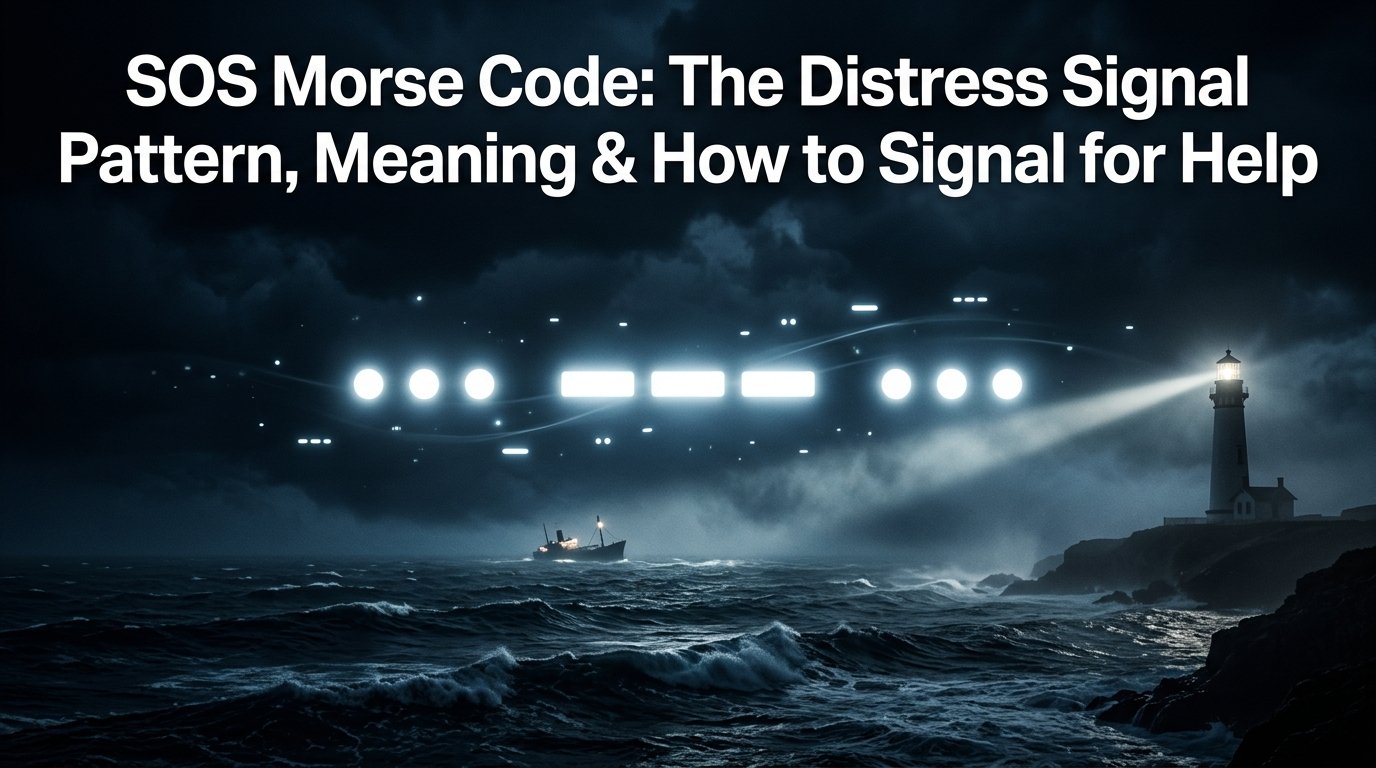
SOS in Morse code is · · · — — — · · · (three dots, three dashes, three dots). It is the international distress signal used to call for urgent help. The signal is sent as one continuous, unbroken sequence—not three separate letters. Contrary to popular belief, SOS does not stand for “Save Our Souls” or “Save Our Ship.” It was chosen simply because the pattern is easy to recognise and impossible to confuse with anything else.
The International Radiotelegraph Convention adopted SOS in 1906, and it became the worldwide standard on 1 July 1908. Today, even though modern technology has largely replaced Morse code for maritime emergencies, SOS remains universally recognised as a call for help that you can signal with light, sound, tapping, or any method where you can make short and long signals.
What Does SOS Look Like in Morse Code?
The SOS signal uses a simple pattern that anyone can learn in seconds. In Morse code, the letter S is three short signals (dots), and the letter O is three long signals (dashes). Put them together, and you get the famous SOS pattern.
Here is how SOS looks in different formats:
| Format | How It Looks |
|---|---|
| Dots and Dashes | · · · — — — · · · |
| Text Version | … — … |
| Block Style | ▄ ▄ ▄ ▄▄▄ ▄▄▄ ▄▄▄ ▄ ▄ ▄ |
| Spoken Sound | Dit Dit Dit Dah Dah Dah Dit Dit Dit |
| Formal Notation | S̅O̅S̅ (with overscore) |
One important point: SOS is written with an overscore in formal Morse notation (S̅O̅S̅) to show that all the signals run together without gaps between the letters. This makes the pattern completely unique and unmistakable.
The same dot-dash sequence could technically spell other letter combinations like IWB, VZE, 3B, or V7. However, “SOS” became the standard because it is the easiest to remember. You can view the complete Morse code sheet to see how all letters and numbers are represented.
Memory Trick: Think “3-3-3″—three short, three long, three short. This symmetry makes SOS recognisable even in stressful situations. For more helpful techniques, visit our basics and tips guide.
What Does SOS Sound Like?
The sound of SOS is distinctive and instantly recognisable once you have heard it. It follows a clear rhythm: three quick beeps, three longer beeps, then three quick beeps again.
When spoken aloud using Morse code phonetics, it sounds like:
“Dit-dit-dit… Dah-dah-dah… Dit-dit-dit”
A “dit” is a quick, short tone. A “dah” is a longer tone—exactly three times the length of a dit. The entire SOS signal takes approximately 8 seconds when sent at standard speed. You can hear exactly how this sounds using our Morse code audio translator.
The rhythm is what makes SOS so effective. Even if you have never studied Morse code, the pattern of short-long-short stands out clearly against background noise. This is precisely why Samuel Morse and his assistant Alfred Lewis Vail designed the code this way—to make important signals easy to distinguish.
The standard radio transmission frequency for SOS distress calls was 500 kHz for radiotelegraphy and 2182 kHz for radiotelephony. Ships’ radio rooms had clocks with special markings indicating mandatory silence periods at 15 and 45 minutes past the hour on 500 kHz to ensure weak distress signals could be heard.
Exact Timing for SOS in Morse Code
Getting the timing right helps others recognise your signal. Here is how long each part should last:
| Element | Duration | What It Means |
|---|---|---|
| Dot (Dit) | 1 time unit | Quick, short signal |
| Dash (Dah) | 3 time units | Three times longer than a dot |
| Gap between signals | 1 time unit | Brief pause within a letter |
| Gap between letters | 3 time units | Slightly longer pause |
| Gap between SOS repeats | 7 time units | Longest pause before starting again |
At 20 words per minute (the standard Morse code speed), one dot lasts approximately 60 milliseconds, making a dash about 180 milliseconds.
Complete Timing Breakdown:
Signal: ▄ ▄ ▄ ▄▄▄ ▄▄▄ ▄▄▄ ▄ ▄ ▄
Units: 1 1 1 3 3 3 3 3 1 1 1
S O S
For emergency signalling, you do not need to be perfectly precise. The golden rule is: slow and clear beats fast and sloppy. Make sure your short signals are noticeably shorter than your long signals, and anyone watching or listening will understand.
Pro Tip: When signalling SOS, pause for 2-3 seconds after completing the full sequence, then repeat. This gives rescuers time to locate your position and confirms you are deliberately signalling—not just making random flashes.
What Does SOS Stand For?
Here is a fact that surprises most people: SOS does not stand for anything. It is not an acronym at all.
You have probably heard that SOS means “Save Our Souls” or “Save Our Ship.” These phrases sound believable, but they were invented years after SOS was already in use. Linguists call these “backronyms”—meanings created after the fact to explain something that never had a meaning in the first place.
| Common Belief | The Truth |
|---|---|
| “Save Our Souls” | Backronym—created after 1908 |
| “Save Our Ship” | Backronym—created after 1908 |
| “Send Out Succour” | Backronym—created after 1908 |
| “Survivors On Ship” | Backronym—created after 1908 |
| Chosen for its meaning | False—chosen purely for its pattern |
According to The Sailors’ Magazine and Seaman’s Friend (October 1915), the associations with “Save Our Souls” emerged in popular usage only after SOS had already become the international standard. The 1906 International Radiotelegraph Convention specified only the dot-dash sequence, with no mention of what letters it represented.
Interestingly, in American Morse Code (which was used by many coastal ships in the United States through the early twentieth century), three dashes represented the numeral “5” rather than the letter “O.” This meant some American operators informally referred to the distress signal as “S 5 S”.
The truth is wonderfully practical: SOS was chosen because its pattern—three dots, three dashes, three dots—is simple, symmetrical, and impossible to mistake for anything else. In an emergency, that simplicity saves lives.
History of the SOS Distress Signal
The story of SOS begins in the early days of wireless telegraphy, when ships first started using radio to communicate across the ocean. To fully understand what is Morse code and its significance, it helps to know this history.
The Need for a Universal Distress Signal
In 1903, Captain Quintino Bonomo, an Italian representative at the Berlin Preliminary Conference on Wireless Telegraphy, discussed the need for common operating procedures. He suggested that “ships in distress… should send the signal SSS DDD at intervals of a few minutes.” However, procedural questions were beyond the scope of that conference, so no standard signal was adopted at the time.
Without international regulations, individual organisations developed their own practices, creating a dangerous situation where different ships used different distress calls.
Before SOS: The CQD Signal
The Marconi International Marine Communication Company, the largest wireless company of the time, created its own distress call: CQD. On 7 January 1904, Marconi issued “Circular 57,” which instructed all its ship installations to use CQD starting from 1 February 1904.
Many people believed CQD stood for “Come Quick, Danger,” though like SOS, this was a backronym. The letters “CQ” were actually a general call used by radio stations to indicate they wanted to communicate with someone, and “D” was simply appended to indicate distress.
The problem? Not everyone used Marconi equipment, and not everyone knew what CQD meant. The U.S. Navy proposed an alternative, suggesting that the International Code of Signals flag signals should be adopted for radio use, including “NC,” which stood for “In distress; want immediate assistance”.
Germany Adopts SOS (1905)
Germany was the first country to officially adopt the SOS signal. German maritime radio regulations, effective from 1 April 1905, included three standard Morse code sequences:
| German Name | Morse Pattern | Purpose |
|---|---|---|
| Ruhezeichen | — — — — — — (OO) | Cease sending |
| Notzeichen | · · · — — — · · · (SOS) | Distress signal |
| Suchzeichen | · · · — — — · (SOE) | Calling signal |
The distress signal was called “Notzeichen” (German for “distress sign”) and used the now-famous three dots, three dashes, three dots pattern.
International Adoption (1906-1908)
In 1906, delegates from around the world gathered in Berlin for the first International Radiotelegraph Convention. They agreed that the world needed one universal distress signal. Article XVI of the convention specified: “Ships in distress shall use the following signal: · · · — — — · · · repeated at brief intervals”.
The agreement was signed on 3 November 1906 and became effective on 1 July 1908. From that date, SOS was the official international distress signal.
Complete Historical Timeline
| Date | Event |
|---|---|
| 1903 | Captain Quintino Bonomo proposes SSS DDD at Berlin Conference |
| 7 January 1904 | Marconi company issues Circular 57, adopting CQD |
| 1 February 1904 | CQD becomes effective for Marconi installations |
| 1 April 1905 | Germany adopts SOS (Notzeichen) nationally |
| 3 November 1906 | International Radiotelegraph Convention signed in Berlin |
| 12 January 1907 | First press reference to “SOS” (Electrical World) |
| 1 July 1908 | SOS becomes the international standard |
| 10 June 1909 | RMS Slavonia sends first reported SOS (Azores) |
| 11 August 1909 | SS Arapahoe sends first US SOS (North Carolina) |
| 15 April 1912 | RMS Titanic uses both CQD and SOS |
| 20 January 1914 | TTT safety signal adopted (London Convention) |
| 1927 | “Mayday” voice code adopted |
| 1 February 1999 | Global Maritime Distress and Safety System replaces SOS |
The Titanic and SOS
The 1912 sinking of the RMS Titanic brought SOS into public awareness worldwide. The ship’s wireless operators, Harold Bride and Jack Phillips, famously sent both the old CQD signal and the newer SOS as the ship went down in the North Atlantic.
As late as April 1912, the ship’s Marconi operators intermixed CQD and SOS distress calls. After this tragedy, the use of CQD effectively died out, and SOS became the universally accepted distress signal.
First SOS Transmissions
The first ships reported to have transmitted an SOS distress call were:
- RMS Slavonia — 10 June 1909, a Cunard oceanliner shipwrecked near the Azores. Two other ships received her signals and went to the rescue.
- SS Arapahoe — 11 August 1909, off the North Carolina coast near the dangerous “Graveyard of the Atlantic.” The signal was received by the United Wireless Telegraph Company station at Hatteras.
The SS Arapahoe holds a special place in history. Its wireless operator, T.D. Haubner, sent what is considered the first SOS transmission received in the United States. Remarkably, Haubner later became the second person to receive an SOS when he picked up a distress call from the SS Iroquois a few months later.
Other Historical SOS Calls
Several famous maritime disasters involved the SOS signal:
| Ship | Year | Event |
|---|---|---|
| Steamship Kentucky | 1910 | Sank; early SOS use saved all 46 lives |
| RMS Titanic | 1912 | Used both CQD and SOS |
| RMS Lusitania | 1915 | Torpedoed by German submarine |
| HMHS Britannic | 1916 | Sank after striking a mine |
| SS Andrea Doria | 1956 | Collision and sinking |
How to Signal SOS in an Emergency
You do not need any special equipment to signal SOS. Any method that lets you make short and long signals will work. The key is consistency—make your short signals clearly shorter than your long ones, and keep repeating the pattern until help arrives.
Here are the most common ways to signal SOS:
| Method | Best Used For | Effective Range |
|---|---|---|
| Flashlight or torch | Night-time, long distance | Several miles |
| Signal mirror | Daytime, to aircraft | Up to 10+ miles |
| Tapping or knocking | Confined spaces, trapped | Through walls and floors |
| Whistling | Outdoors, wilderness | Several hundred metres |
| Eye blinking | Covert or hostage situations | Close range only |
| Fire or smoke | Wilderness survival | Visible for miles |
| Horn or siren | Maritime, low visibility | Several miles |
Pro Tip: You do not need to memorise the entire Morse alphabet to use SOS effectively. This one signal alone could save your life or someone else’s. However, if you want to learn Morse code more comprehensively, we have resources to help you.
How to Signal SOS With a Flashlight
Signalling SOS with a torch is one of the most practical emergency skills you can learn. Here is exactly how to do it:
Step-by-Step Instructions
- Three Short Flashes (S)
- Turn your torch ON for about half a second
- Turn it OFF for half a second
- Repeat two more times (three quick flashes total)
- Brief Pause
- Wait about half a second
- Three Long Flashes (O)
- Turn your torch ON for about 1.5 seconds
- Turn it OFF for half a second
- Repeat two more times (three slow flashes total)
- Brief Pause
- Wait about half a second
- Three Short Flashes (S)
- Same as Step 1
- Long Pause
- Wait 2-3 seconds
- Repeat
- Keep going until help arrives
SOS is still recognised as a standard distress signal that may be used with any signalling method, including three short/three long/three short flashes of light.
Pro Tips:
- Point your light toward where rescuers are most likely to be
- Get to higher ground if possible—elevation improves visibility
- A signal mirror in daylight can be seen from over 10 miles away by aircraft
- Many modern torches include an automatic SOS mode—check your gear before emergencies
How to Tap SOS in Morse Code
If you are trapped—in a collapsed building, locked room, or buried under debris—tapping SOS could be the signal that saves your life.
Tapping Technique
| Signal | How to Tap |
|---|---|
| Dot (·) | Quick, light tap |
| Dash (—) | Firmer tap held slightly longer |
| Gap between elements | Brief pause |
| Gap between SOS repeats | 2-3 second pause |
Best Surfaces for Tapping
Sound travels through solid materials better than air. These surfaces work well:
- Metal pipes — Excellent for carrying sound long distances
- Walls — Especially drywall or concrete
- Floors — Wooden floors resonate well
- Doors — Solid doors carry sound effectively
- Any hard surface that resonates
The pattern is simple: tap-tap-tap (quick), TAP-TAP-TAP (slower and firmer), tap-tap-tap (quick). Pause. Repeat.
A Reddit user shared a compelling real-world example: an elderly woman who fell in her bathroom and could not reach her phone used a wooden rod to tap SOS on walls and floors for over 12 hours. A neighbour eventually recognised the pattern and called emergency services, saving her life.
Pro Tip: Tap in multiple directions—on walls, floors, and pipes. Sound travels unpredictably through structures, and you cannot know where rescuers might be listening.
How to Whistle SOS
In outdoor emergencies—hiking accidents, getting lost in wilderness, or becoming separated from your group—whistling SOS can attract attention from far away.
Whistling Pattern
| Signal | What to Do |
|---|---|
| S (· · ·) | Three quick, short whistle blasts |
| O (— — —) | Three long, sustained whistle blasts |
| S (· · ·) | Three quick, short whistle blasts |
Timing Guide
- Short blast: About half a second
- Long blast: About 1.5 seconds
- Pause between letters: About 1 second
- Pause before repeating: About 3 seconds
An emergency whistle is far better than mouth whistling—it is louder and uses less energy. Many survival whistles produce sounds exceeding 100 decibels, audible over a mile away in quiet conditions.
Pro Tip: Three signals of any kind (flashes, whistle blasts, fires) arranged in groups of three is also a universal distress signal, even without the specific SOS rhythm.
How to Blink SOS With Your Eyes
This method is for extreme situations—when you cannot speak safely, such as a hostage scenario or when someone dangerous is nearby.
Blinking Pattern
| Signal | Eye Action |
|---|---|
| Dot (·) | Quick, normal blink |
| Dash (—) | Extended eye closure (about 1 second) |
The sequence: blink-blink-blink (quick) → close-close-close (long holds) → blink-blink-blink (quick)
This method gained public awareness through viral videos and news stories of people rescued after blinking SOS to alert others. However, it only works if the person watching knows to look for it.
Important: Eye-blinking SOS requires the observer to be actively watching and trained to recognise the pattern. It works best in close-range, face-to-face situations.
How to Use Fire or Smoke to Signal SOS
In wilderness survival situations, fire and smoke can signal distress over great distances, especially to search aircraft.
Fire Signal Methods
| Method | Technique | Best Time |
|---|---|---|
| Three fires in triangle | Build 3 fires in triangular formation | Night |
| Smoke puffs | Cover/uncover fire with blanket | Day |
| Flashing firelight | Block/reveal flames with barrier | Night |
Three fires arranged in a triangle is an internationally recognised distress signal, visible to search aircraft from great distances.
For smoke signals during daytime, green vegetation on a fire creates thick white smoke against dark backgrounds, while oil or rubber creates black smoke visible against light backgrounds.
Safety Warning: Only use fire signals when it is safe to do so. Never start fires during high fire-danger conditions or in locations where the fire could spread uncontrollably.
SOS vs Other Distress Signals
SOS is not the only distress signal, but it is the most famous. Here is how it compares to other emergency signals:
| Signal | How It’s Sent | Morse Code | Meaning | When to Use |
|---|---|---|---|---|
| SOS | Light, sound, visual | · · · — — — · · · | Extreme distress | Life-threatening emergency |
| Mayday | Voice radio | N/A | Life-threatening | Spoken emergency calls |
| CQD | Radio (obsolete) | — · — · — — · — — · · | “Come Quick, Danger” | Historical only |
| Pan-Pan | Voice radio | XXX | Urgent but not deadly | Serious but controlled |
| Sécurité | Voice radio | TTT | Safety warning | Navigation hazards |
Mayday: The Voice Equivalent of SOS
When voice radio became common, a spoken equivalent to SOS was needed. In 1927, the International Radio Convention adopted “Mayday” for this purpose. The word comes from the French “m’aider” (help me).
To use Mayday properly, you say it three times: “Mayday, Mayday, Mayday.”
TTT: The Safety Signal
The safety signal TTT was adopted on 20 January 1914 by the London International Convention on Safety of Life at Sea. It is used for messages to ships “involving safety of navigation and being of an urgent character” but short of an emergency.
The TTT signal is sent as three separate letters (with normal spacing between them) specifically so it cannot be confused with the three dashes of the letter O.
Pan-Pan: Urgent but Not Life-Threatening
Pan-Pan (from the French panne, meaning “breakdown”) signals an urgent situation that is not immediately life-threatening. The Morse code equivalent is XXX. It is used for situations like mechanical failures that require assistance but do not pose immediate danger to life.
World War II Suffix Codes
During the Second World War, additional codes were used alongside SOS to give immediate details about attacks in the Battle of the Atlantic:
| Code | Meaning |
|---|---|
| SSS | Attacked by submarines |
| RRR | Attacked by surface raider |
| QQQ | Unknown raider (auxiliary cruiser) |
| AAA | Attacked by aircraft |
These codes were never sent alone—they always accompanied an SOS signal. All later switched from three letter repeats to four (e.g., RRRR).
Is SOS Still Used Today?
Yes, absolutely. While technology has changed how emergencies are communicated at sea, SOS remains universally recognised.
SOS remained the official maritime radio distress signal until 1 February 1999, when it was replaced by the Global Maritime Distress and Safety System (GMDSS). However, SOS is still recognised as a standard distress signal that can be used with any signalling method.
Modern Applications of SOS
| Where | How SOS Is Used |
|---|---|
| Smartphones | Emergency SOS features on iPhone and Android |
| Survival torches | Many include automatic SOS flashing mode |
| Personal locator beacons | Satellite emergency transmission |
| Smartwatches | Apple Watch, Galaxy Watch emergency features |
| Amateur radio | Still monitored by operators worldwide |
| Visual signalling | Universally recognised by rescue teams |
| Vehicle emergency systems | Some cars include SOS buttons |
The Auto-Alarm System
Before GMDSS, ships used an automatic alarm system to summon radio operators who might be off-duty. The radiotelegraph alarm signal consisted of twelve extra-long dashes, each lasting four seconds with a one-second gap between them. This signal was transmitted before SOS to activate alarm bells in the operator’s cabin and on the bridge.
Ships’ radio room clocks had special markings showing mandatory silence periods at 15 and 45 minutes past the hour on 500 kHz, and at the hour and half-hour on 2182 kHz. All communication had to stop during these periods to ensure weak distress signals could be heard.
Pro Tip: Check your smartphone settings—most modern phones have an SOS emergency feature that can contact emergency services and share your location automatically.
Quick Reference: SOS Morse Code Cheat Sheet
Keep this pattern in mind. It could save a life someday. For a complete reference of all characters, see our Morse code sheet.
║ SOS MORSE CODE ║
╠═══════════════════════════════════════════════════════╣
║ PATTERN: · · · — — — · · · ║
║ S O S ║
║ ║
║ SOUND: dit dit dit dah dah dah dit dit dit ║
║ ║
║ TIMING: short short short ║
║ LONG LONG LONG ║
║ short short short ║
║ ║
║ REMEMBER: 3 quick, 3 slow, 3 quick ║
║ ║
║ REPEAT until help arrives ║
╚═══════════════════════════════════════════════════════╝
Copy-Paste Formats
| Format | Text to Copy |
|---|---|
| Dots and Dashes | · · · — — — · · · |
| Periods and Hyphens | … — … |
| Unicode Blocks | ▄ ▄ ▄ ▄▄▄ ▄▄▄ ▄▄▄ ▄ ▄ ▄ |
| Plain Text | SOS |
Want to convert other text to Morse code? Use our free Morse code translator to instantly translate any message.
Frequently Asked Questions
What is the Morse code for SOS?
The Morse code for SOS is · · · — — — · · · (three dots, three dashes, three dots). It is transmitted as one continuous sequence without spaces between the letters, making it a unique “prosign” or procedural signal in Morse code terminology.
What does SOS stand for?
SOS does not stand for anything. It is not an acronym. Phrases like “Save Our Souls” and “Save Our Ship” are backronyms—meanings invented after the signal was already in use. SOS was chosen purely because its dot-dash pattern is distinctive, simple, and easy to recognise in emergencies.
How do you signal SOS with a flashlight?
Flash your torch three times quickly (short flashes of about half a second), then three times slowly (long flashes of about 1.5 seconds), then three times quickly again. Pause for 2-3 seconds and repeat until help arrives.
How do you tap SOS in Morse code?
Tap three quick taps, followed by three slower, firmer taps, then three quick taps again. Pause briefly and repeat. This works on walls, floors, pipes, or any hard surface that carries sound well.
Is SOS still used today?
Yes. While the Global Maritime Distress and Safety System (GMDSS) replaced SOS for official maritime radio communications in 1999, SOS remains universally recognised. It can be used with any signalling method—light, sound, or visual signals—and is understood by rescue teams worldwide.
When was SOS first used?
Germany first adopted SOS on 1 April 1905. It became the international standard on 1 July 1908. The first ships reported to have transmitted SOS were the RMS Slavonia (10 June 1909) and the SS Arapahoe (11 August 1909).
What was used before SOS?
Before SOS became the international standard, the Marconi International Marine Communication Company used CQD, which was adopted on 1 February 1904. The U.S. Navy also proposed using the flag signal “NC” for radio distress calls.
Why was SOS chosen as the distress signal?
SOS was chosen because its pattern—three dots, three dashes, three dots—is unmistakable, easy to transmit, and simple to recognise even under stress or in noisy conditions. It was not chosen for any specific meaning or because of what the letters represent.
How long is a dot versus a dash in Morse code?
A dot (dit) is 1 time unit long. A dash (dah) is 3 time units long—exactly three times longer than a dot. The gap between signals within a letter is 1 unit, between letters is 3 units, and between words is 7 units.
What is the difference between SOS and Mayday?
Both signal life-threatening emergencies, but SOS is transmitted using Morse code (dots and dashes) via light, sound, or radio, while Mayday is a spoken voice signal used over radio. Mayday was adopted in 1927 as the voice equivalent of SOS.
Learn More About Morse Code
Now that you understand SOS, you might want to explore Morse code further. Here are some helpful resources:
- What is Morse Code? — A complete introduction to the history and fundamentals
- Morse Code Translator — Convert any text to Morse code instantly
- Morse Code Audio Translator — Hear how Morse code sounds
- Morse Code Sheet — Complete alphabet and number reference
- Common Morse Code Words — Frequently used words in Morse code
- Learn Morse Code — Tutorials and learning resources