
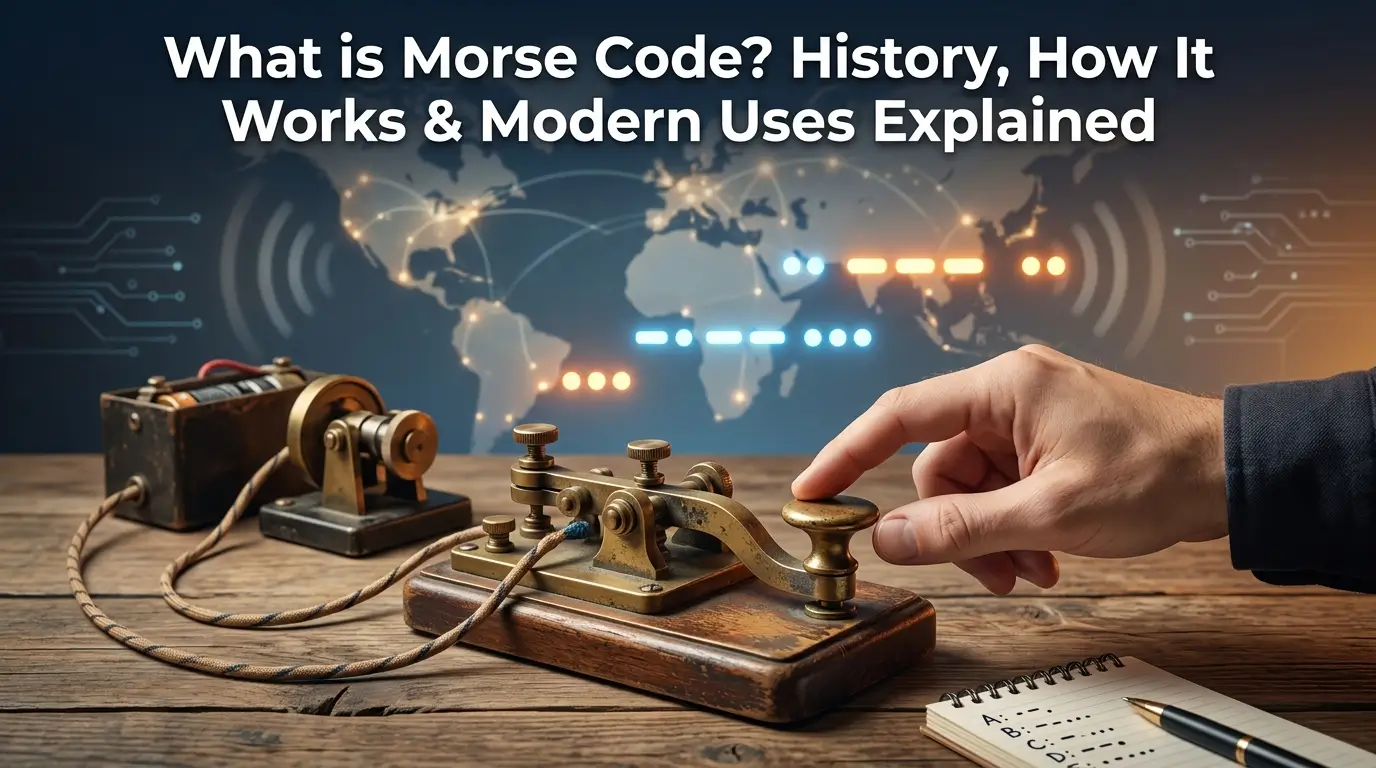
Morse code is a communication system that encodes letters, numbers, and punctuation into sequences of short signals called dots (dits) and long signals called dashes (dahs). Samuel Morse and Alfred Vail invented this encoding method in the 1830s for the electric telegraph, enabling instant long-distance messaging through electrical pulses, sound, or light.
The genius of Morse code lies in its elegant simplicity. The entire English alphabet transmits using just two signal types. The letter ‘E’—the most common letter in English—requires only a single dot (·). Alfred Vail designed this frequency-based system after counting letters in a printer’s type case, assigning shorter codes to common letters and longer codes to rare ones.
Though the telegraph era ended decades ago, Morse code remains remarkably alive. Amateur radio operators use it daily across the globe. Aviation navigation beacons transmit station identifiers in Morse. People with motor disabilities communicate through smartphone apps like Google’s Gboard. The system that once connected continents now helps people who cannot speak express their thoughts.
“I’ve been a ham radio operator for 35 years, and Morse code—what we call CW—still cuts through interference better than any voice transmission. When conditions are poor, CW gets through when nothing else will.” — David Sumner, former CEO of the American Radio Relay League
How Does Morse Code Work?
Morse code operates through a precise system of timed signals and spaces. Understanding this timing structure reveals how two simple elements can encode any message.
The Basic Components
Every Morse code transmission consists of five elements:
- Dot (dit): A short signal lasting 1 time unit
- Dash (dah): A long signal lasting exactly 3 time units
- Intra-character gap: 1 time unit of silence between dots and dashes within a letter
- Inter-letter gap: 3 time units of silence between letters
- Inter-word gap: 7 time units of silence between words
| Element | Duration | Purpose |
| Dot (dit) | 1 unit | Basic short signal |
| Dash (dah) | 3 units | Basic long signal |
| Within letter | 1 unit | Separates signals in same letter |
| Between letters | 3 units | Marks letter boundaries |
| Between words | 7 units | Marks word boundaries |
Key Point: A dash lasts exactly three times longer than a dot. This precise 3:1 timing ratio makes Morse code universally readable regardless of transmission speed—whether 5 words per minute or 40.
Why Letters Have Different Code Lengths
Samuel Morse and Alfred Vail did not assign codes randomly. They applied frequency analysis to optimise transmission efficiency.
Alfred Vail visited a printing shop in Morristown, New Jersey, and counted letters in the compositor’s type case. He discovered that ‘E’ appeared far more frequently than any other letter. Consequently, ‘E’ received the shortest possible code—a single dot (·). The letter ‘T’, second most common, received one dash (−).
Rare letters like ‘Q’ (−−·−) and ‘Z’ (−−··) received longer codes because they appear less frequently in English text. This frequency-based design reduced average transmission time by approximately 20% compared to arbitrary code assignment.
| Letter Frequency | Example Letters | Code Length |
| Very common | E, T | 1 signal |
| Common | A, I, N | 2 signals |
| Moderate | D, R, S, U | 3 signals |
| Less common | B, C, F, K, L, P | 4 signals |
| Rare | Q, X, Y, Z | 4 signals (complex patterns) |
💡 Learning Tip: Morse code follows a binary tree structure. Starting from the root, moving left represents a dot, moving right represents a dash. Tracing the correct branch path leads to any letter—a technique called the dichotomic search method.
Morse Code Alphabet Chart
The International Morse Code standardised by the International Telecommunication Union (ITU) serves as the global standard. This version replaced the original American Morse Code in international use after 1865.
For a complete visual reference, see our Morse code alphabet chart.
Letters A–Z
| Letter | Code | Letter | Code |
| A | ·− | N | −· |
| B | −··· | O | −−− |
| C | −·−· | P | ·−−· |
| D | −·· | Q | −−·− |
| E | · | R | ·−· |
| F | ··−· | S | ··· |
| G | −−· | T | − |
| H | ···· | U | ··− |
| I | ·· | V | ···− |
| J | ·−−− | W | ·−− |
| K | −·− | X | −··− |
| L | ·−·· | Y | −·−− |
| M | −− | Z | −−·· |
Numbers 0–9
| Number | Code | Number | Code |
| 1 | ·−−−− | 6 | −···· |
| 2 | ··−−− | 7 | −−··· |
| 3 | ···−− | 8 | −−−·· |
| 4 | ····− | 9 | −−−−· |
| 5 | ····· | 0 | −−−−− |
Common Punctuation
| Symbol | Code | Symbol | Code |
| Full stop (.) | ·−·−·− | Comma (,) | −−··−− |
| Question mark (?) | ··−−·· | Apostrophe (‘) | ·−−−−· |
| @ symbol | ·−−·−· | Forward slash (/) | −··−· |
The @ symbol was added in 2004—the first new International Morse Code character in several decades—to accommodate email addresses in amateur radio communication. (Source: Engineering and Technology History Wiki)
Who Invented Morse Code?
The creation of Morse code resulted from collaboration between an artist-turned-inventor and an engineer whose contributions history often overlooks.
Samuel Morse: From Portrait Artist to Inventor
Samuel Finley Breese Morse was born on 27 April 1791 in Charlestown, Massachusetts, to Jedidiah Morse, a distinguished geographer and Congregationalist minister. After attending Phillips Academy and Yale College, Morse pursued painting rather than the ministry his parents preferred.
Morse became a successful portrait artist, painting notable figures including President John Adams, the Marquis de Lafayette, and poet William Cullen Bryant. His work demonstrated technical competence and bold character rendering with Romantic influences from his studies under Washington Allston in England.
Personal tragedy sparked Morse’s pivot to invention. In February 1825, whilst painting a portrait in Washington, D.C., his wife Lucretia died suddenly in New Haven, Connecticut. A horse messenger brought the news, but by the time Morse arrived, his wife had already been buried. He had missed both her final moments and her funeral.
This devastating experience planted an obsession: finding a way to transmit messages faster than horses could carry them.
In 1832, whilst sailing home from Europe aboard the packet ship Sully, Morse overheard a conversation about electromagnetism. The idea crystallised immediately—electrical signals could travel along wires almost instantaneously. He spent the remainder of the voyage sketching telegraph designs.
Fact: Samuel Morse was a renowned portrait artist who painted President John Adams, the Marquis de Lafayette, and other prominent figures before turning to invention. His artistic career funded his telegraph experiments. (Source: Encyclopaedia Britannica)
Alfred Vail: The Essential Partner
Alfred Lewis Vail deserves far more recognition than history typically grants him. Born in 1807, Vail was an engineer and businessman whose family owned the Speedwell Ironworks in Morristown, New Jersey.
In September 1837, Vail witnessed a demonstration of Morse’s telegraph prototype at New York University. Recognising its potential immediately, he proposed a partnership. Vail offered funding, materials, skilled labour from the family ironworks, and—most importantly—his engineering expertise.
Vail’s contributions proved essential:
- Improved mechanical design of the telegraph transmitter and receiver
- Developed the practical code system by analysing letter frequency in printer’s type cases
- Created the telegraph key design that became standard
- Assigned shorter codes to common letters, dramatically improving transmission efficiency
Fact: Alfred Vail analysed printer’s type cases to determine letter frequency, then assigned shorter codes to common letters. This frequency optimisation explains why ‘E’ (the most common English letter) requires only one dot. (Source: Twinkl Teaching Wiki)
Leonard Gale, a chemistry professor at New York University, also contributed significantly. Gale introduced Morse to Joseph Henry’s research on electromagnetism. Henry’s powerful electromagnet designs enabled the telegraph to transmit signals over 16 kilometres—far beyond the 12 metres Morse’s original prototype could manage.
When Was Morse Code Invented? Complete Timeline
The development of Morse code and the electric telegraph spanned over a decade, with contributions from multiple inventors and international standardisation efforts.
| Year | Event | Significance |
| 1832 | Morse conceives telegraph idea aboard ship Sully | Initial concept following electromagnet conversation |
| 1835 | First working telegraph prototype completed | Proved electrical messaging feasible |
| 1837 | Alfred Vail joins as partner | Brought funding, engineering expertise, and code optimisation |
| 1838 | Morse and Vail develop dot-dash code system | Created practical encoding method |
| 1843 | U.S. Congress appropriates $30,000 | Funded first American telegraph line |
| 1844 | First official message: ‘What hath God wrought’ (24 May) | Washington D.C. to Baltimore, 40 miles |
| 1848 | Friedrich Clemens Gerke creates Continental code | Simplified version for Hamburg-Cuxhaven line |
| 1851 | European nations adopt standardised code | Basis for International Morse Code |
| 1858 | Queen Victoria sends first transatlantic telegram | Proved intercontinental communication possible |
| 1865 | ITU officially standardises International Morse Code | Became permanent global standard |
| 1901 | Guglielmo Marconi transmits Morse wirelessly across Atlantic | Demonstrated radio telegraphy feasibility |
| 1912 | RMS Titanic disaster | Demonstrated critical importance of maritime Morse |
| 1999 | GMDSS replaces Morse for commercial maritime use | End of mandatory commercial Morse |
Fact: The first official Morse code message—’What hath God wrought’—was transmitted on 24 May 1844 from the Supreme Court chamber in Washington D.C. to Baltimore, Maryland, covering 40 miles. The biblical phrase (Numbers 23:23) was chosen by Annie Ellsworth, daughter of the U.S. Patent Commissioner. (Source: Encyclopaedia Britannica)
International Morse Code vs American Morse Code
Two distinct versions of Morse code existed, and understanding their differences explains why international standardisation became necessary.
American Morse Code (Original Version)
The original code developed by Morse and Vail in the 1830s became known as American Morse Code or Railroad Morse. American telegraph companies and railroad networks used this version extensively throughout the nineteenth century.
American Morse Code had several complexities:
- Variable dash lengths: Some characters used short dashes, others long dashes
- Internal spaces: Certain letters included pauses within the character
- Greater complexity: Required more skilled operators
International Morse Code (Modern Standard)
In 1848, German engineer Friedrich Clemens Gerke created a simplified version for the Hamburg-Cuxhaven telegraph line in Germany. This Continental code eliminated variable dash lengths and internal spaces.
European nations formally adopted this standardised version in 1851. The International Telecommunication Union (ITU) made it the permanent global standard in 1865, where it has remained with only minor modifications (most recently in 1938 and 2004).
| Feature | American Morse Code | International Morse Code |
| Dash lengths | Variable (short and long) | Constant (always 3× dot length) |
| Internal spaces | Used in some letters | Never used |
| Complexity | Higher | Lower |
| Learning difficulty | Harder | Easier |
| Current status | Obsolete | Global standard |
| Primary historical use | U.S. railroads | International telegraphy |
Fact: International Morse Code uses dashes of constant length, whilst the original American Morse Code employed variable-length dashes. Only four character codes remained identical between both systems: E, H, K, and N. (Source: Encyclopaedia Britannica)
The American telegraph industry continued using the original code until teleprinters replaced Morse transmission in the 1920s and 1930s.
What Was Morse Code Used For? Historical Applications
Before telephones, before radio broadcasting, before the internet—the electric telegraph and Morse code revolutionised human communication in ways comparable to the smartphone revolution of the twenty-first century.
Telegraph Communication
The electric telegraph transformed long-distance communication fundamentally. Before its invention, messages travelled only as fast as horses, ships, or carrier pigeons. Important news might take days, weeks, or months to arrive.
With the telegraph, messages crossed continents in minutes. By 1852—just eight years after the first message—over 23,000 miles of telegraph lines crisscrossed the United States. (Source: Twinkl Teaching Wiki)
The telegraph transformed multiple domains:
- Business: Merchants checked commodity prices in distant cities instantly
- Journalism: News agencies reported events on the same day they occurred
- Government: Political leaders coordinated actions across vast territories
- Military: Commanders received battlefield intelligence in near real-time
- Personal: Families shared urgent news immediately
President Abraham Lincoln relied heavily on telegraph communication during the American Civil War, spending hours in the War Department telegraph office receiving battlefield updates.
Maritime Communication
Morse code became essential for ships at sea after Guglielmo Marconi demonstrated wireless telegraphy in 1901 by transmitting the letter ‘S’ (···) across the Atlantic Ocean.
Before radio, vessels were completely isolated once they left port. Wireless Morse telegraphy changed maritime safety fundamentally. Ships could now communicate with shore stations and other vessels, summon help in emergencies, and receive weather warnings.
The most famous maritime use of Morse code occurred during the RMS Titanic disaster on 15 April 1912. Radio operators Jack Phillips and Harold Bride transmitted desperate distress signals as the ship sank. They sent both the older ‘CQD’ signal and the newer ‘SOS’ call. Phillips continued transmitting until the power failed, going down with the ship.
The RMS Carpathia received these signals and changed course immediately, eventually rescuing 710 survivors.
Fact: The Titanic’s radio operators initially transmitted the older ‘CQD’ distress signal before switching to the newer ‘SOS’. Harold Bride later reported that senior operator Jack Phillips jokingly said it might be his last chance to send the new signal. (Source: BBC Bitesize)
Military Operations
Morse code played crucial roles in both World Wars and subsequent conflicts.
During World War I, military forces on all sides used Morse code extensively for command communication. The technology had matured enough that portable field telegraph units could be deployed near front lines.
During World War II, Morse code became even more critical:
- The Special Operations Executive (SOE) trained secret agents to use portable radio transmitters disguised as ordinary suitcases. These agents parachuted into Nazi-occupied Europe and transmitted vital intelligence back to Britain using Morse code.
- Ships used Aldis lamps—powerful signal lights—to transmit Morse code visually between vessels. This method avoided radio transmissions that enemy forces could intercept and locate.
- The Navajo Code Talkers used Morse code transmission methods alongside their unbreakable native language codes.
Fact: During World War II, British Special Operations Executive agents carried radio transmitters disguised as suitcases to transmit intelligence from occupied Europe using Morse code. Ships used Aldis lamps for visual Morse communication to avoid radio interception. (Source: BBC Bitesize)
What Is Morse Code Used for Today?
Morse code’s commercial era ended in 1999 when the Global Maritime Distress and Safety System (GMDSS) replaced it for maritime communication. However, reports of its death have been greatly exaggerated.
Amateur Radio (Ham Radio)
The largest community of Morse code users today comprises amateur radio operators, often called ‘hams’. Thousands of operators worldwide communicate daily using Morse code, which they call ‘CW’ (continuous wave).
Why do experienced operators prefer Morse over voice communication?
- Superior noise penetration: Morse signals cut through static and interference that renders voice transmissions unintelligible
- Lower bandwidth: Morse requires less frequency spectrum than voice modes
- Greater range: The same transmitter power achieves longer distances with Morse than voice
- Equipment simplicity: Basic Morse equipment costs less and fails less often
Most countries removed Morse proficiency requirements from amateur radio licence examinations in the early 2000s. Yet many operators choose to learn it anyway, recognising its practical advantages and the satisfaction of mastering a historic skill.
“There’s something almost meditative about operating CW. The whole world goes quiet except for that tone in your headphones. And when band conditions are marginal, CW gets through when SSB [voice] is just noise.” — Steve Ford, former editor of QST magazine
Aviation Navigation
Aircraft navigation beacons still use Morse code. VOR (VHF Omnidirectional Range) and NDB (Non-Directional Beacon) stations continuously transmit their identification codes in Morse. Pilots listen to these signals to confirm they are receiving the correct beacon, preventing navigation errors.
For example, London Heathrow’s VOR beacon transmits ‘LON’ (·−·· −−− −·) continuously on frequency 113.60 MHz.
Emergency Signalling
Morse code functions when other communication methods fail. The SOS signal (··· −−− ···) can be transmitted using:
- A torch or flashlight
- A whistle, horn, or car horn
- Tapping on a surface or pipe
- A mirror reflecting sunlight
- Any controllable on-off mechanism
This versatility makes Morse code valuable survival knowledge. The pattern is simple enough to learn in minutes yet distinctive enough to recognise immediately.
💡 Survival Tip: Memorise the SOS signal: three short, three long, three short (··· −−− ···). Tap it, flash it, whistle it, or honk it. This universal distress signal is recognised worldwide and could save your life in an emergency.
Accessibility Technology
One of Morse code’s most important modern applications helps people with disabilities communicate.
Google’s Gboard keyboard includes Morse code input, allowing people with motor disabilities to type using just two switches. A head movement, eye blink, breath (sip-and-puff), or foot tap can produce dots and dashes that convert to text. This feature was developed in collaboration with accessibility advocate Tania Finlayson, who has used Morse code to communicate since childhood.
Fact: Google’s Gboard keyboard includes Morse code input, enabling people with motor disabilities to type using two switches—such as head movements, eye blinks, or sip-and-puff devices. (Source: Google Android Accessibility)
Researchers have developed ‘Morse Glasses’—affordable wearable devices that track eye blinks and translate them into speech using Morse code. Costing less than £25 to build, these devices help patients with motor neuron diseases like ALS (amyotrophic lateral sclerosis) communicate with family and carers. (Source: National Institutes of Health)
Education and Scouting
Morse code remains popular in Scout programmes, STEM education, and coding clubs. Its binary logic—two signal types encoding any character—provides an excellent introduction to:
- Digital encoding principles
- Information theory fundamentals
- Binary number systems
- Data transmission concepts
Famous Morse Code Messages in History
Certain Morse code transmissions changed history. Others demonstrated extraordinary human courage under impossible circumstances.
1. ‘What Hath God Wrought’ (1844)
On 24 May 1844, Samuel Morse sat in the Supreme Court chamber in Washington D.C. and tapped out the first official telegraph message. Forty miles away in Baltimore, Alfred Vail received it instantly and sent the same words back.
The message—‘What hath God wrought’—comes from the Bible (Numbers 23:23). Annie Ellsworth, daughter of U.S. Patent Commissioner Henry Ellsworth, chose the phrase. The words seemed fitting for technology that felt miraculous.
2. Queen Victoria’s Transatlantic Telegram (1858)
On 16 August 1858, Queen Victoria sent a 98-word congratulatory message to U.S. President James Buchanan via the first transatlantic telegraph cable. The message took over 16 hours to transmit—the cable’s signal was extremely weak.
The cable failed completely after just three weeks. But it proved transatlantic communication was possible, paving the way for the more successful cables that followed.
3. Titanic Distress Calls (1912)
As RMS Titanic struck an iceberg and began sinking on 15 April 1912, radio operators Jack Phillips and Harold Bride worked frantically to summon help.
They transmitted both ‘CQD’ (the older British distress signal) and ‘SOS’ (the newer international standard). Phillips continued sending until the power failed, remaining at his post. He died in the sinking; Bride survived.
RMS Carpathia received their signals and changed course immediately, rescuing 710 people.
4. Jeremiah Denton’s Blinked Message (1966)
Perhaps the most extraordinary Morse code message was never tapped or transmitted by radio. It was blinked.
In 1966, captured U.S. Navy Commander Jeremiah Denton appeared in a North Vietnamese propaganda television broadcast. Knowing the interview would be shown in America, he pretended the studio lights were bothering his eyes.
As he spoke, he blinked his eyes in Morse code, spelling: T-O-R-T-U-R-E
American intelligence analysts decoded his message—the first confirmation that American prisoners of war were being tortured in Vietnam. Denton survived nearly eight years of captivity and later became a U.S. Senator.
Fact: In 1966, captured U.S. Navy Commander Jeremiah Denton blinked ‘TORTURE’ in Morse code during a forced television interview, providing the first confirmation that American POWs were being mistreated in Vietnam. He later served as a U.S. Senator from Alabama. (Source: Twinkl Teaching Wiki)
Is Morse Code a Language?
No, Morse code is not a language—it is an encoding system.
This distinction matters because it affects how you think about learning and using Morse code.
A language has its own:
- Vocabulary (unique words with meanings)
- Grammar (rules for combining words)
- Syntax (sentence structure rules)
- Semantics (meaning systems)
Morse code has none of these. Instead, it represents existing languages by converting their letters and numbers into standardised signals. Think of Morse code like:
- The alphabet itself: A writing system, not a separate language
- Braille: An encoding of letters through tactile dots, not a distinct language
- Semaphore: A visual encoding using flag positions
- ASCII: A digital encoding of characters for computers
When you send ‘Hello’ in Morse code (···· · ·−·· ·−·· −−−), you are still communicating in English—just using a different transmission method.
However, experienced Morse operators do develop a kind of procedural language with standardised abbreviations:
| Abbreviation | Meaning |
| CQ | Calling any station |
| 73 | Best regards |
| 88 | Love and kisses |
| OM | Old man (male operator) |
| YL | Young lady (female operator) |
| QTH | Location |
| QSL | Confirmation of contact |
These Q-codes and prosigns function somewhat like a shared vocabulary among operators but do not constitute a separate language.
How to Read Common Words in Morse Code
Learning common words and phrases demonstrates how Morse code functions in practice. These examples are among the most frequently requested.
| Word/Phrase | Morse Code |
| SOS | ··· −−− ··· |
| Hello | ···· · ·−·· ·−·· −−− |
| I love you | ·· / ·−·· −−− ···− · / −·−− −−− ··− |
| Yes | −·−− · ··· |
| No | −· −−− |
| Help | ···· · ·−·· ·−−· |
| OK | −−− −·− |
| Thank you | − ···· ·− −· −·− / −·−− −−− ··− |
| Goodbye | −−· −−− −−− −·· −··· −·−− · |
The forward slash (/) indicates a space between words (7 time units of silence).
Use our Morse code translator to convert any text instantly.
What Does SOS Mean?
SOS (··· −−− ···) is the international distress signal. It does not stand for ‘Save Our Souls’, ‘Save Our Ship’, or any other phrase—these are backronyms invented after the signal was adopted.
The International Radiotelegraph Convention of 1906 in Berlin chose SOS purely because its pattern—three dots, three dashes, three dots—is:
- Distinctive: Unlike any letter combination
- Easy to remember: Simple, symmetrical pattern
- Quick to transmit: Only nine signals
- Unmistakable: Recognisable even through heavy interference
SOS replaced the earlier ‘CQD’ signal (used by British operators) because it was simpler and more universally recognisable.
Key Point: SOS has no inherent meaning. The phrases ‘Save Our Souls’ and ‘Save Our Ship’ were invented later as memory aids. The signal was chosen purely for its distinctive, easy-to-transmit pattern.
Advantages and Disadvantages of Morse Code
Every communication system involves trade-offs. Understanding Morse code’s strengths and limitations explains why it persists despite far more advanced technologies.
| Advantages | Disadvantages |
| Penetrates noise and interference when voice fails | Requires training to encode and decode fluently |
| Requires minimal equipment (light, sound, tapping) | Slower than modern digital communication |
| Universally standardised by the ITU | Limited character set (no accents in basic code) |
| Very low bandwidth requirement | Not intuitive for complex technical messages |
| Accessible for people with severe motor disabilities | Declining number of trained operators |
| Works with improvised signalling methods | Error correction requires manual repetition |
| Highly resilient in emergency situations |
The key advantage remains resilience. A Morse signal can get through when voice communication is impossible. Radio operators describe this as the signal ‘getting down into the noise’—the human ear can detect Morse patterns buried in static that would completely mask voice transmissions.
7 Interesting Facts About Morse Code
- ‘E’ is the shortest code for a reason. Alfred Vail counted letters in a printer’s type case and found ‘E’ most common. Assigning it just one dot (·) reduced average transmission time significantly.
- SOS has no meaning. The international distress signal was chosen purely for its distinctive pattern (··· −−− ···), not as an acronym. ‘Save Our Souls’ and ‘Save Our Ship’ are backronyms invented later.
- Operators develop a recognisable ‘fist’. Experienced receivers can identify individual senders by their unique rhythm, timing quirks, and spacing patterns—much like recognising someone’s handwriting or voice.
- Nokia’s SMS tone is Morse code. The classic Nokia text message alert beeps ‘SMS’ in Morse code (··· −− ···). Nokia engineers included this as an Easter egg.
- The @ symbol was added in 2004. The code (·−−·−·) became the first new International Morse Code character in decades, adopted to accommodate email addresses. (Source: Engineering and Technology History Wiki)
- Learning Morse may improve brain function. Studies suggest that Morse code learning increases neuroplasticity and cognitive processing speed, similar to learning a musical instrument.
- K-pop groups use hidden Morse messages. Artists like TXT (Tomorrow X Together) have incorporated Morse code into album concepts and music videos, creating hidden messages for dedicated fans to decode.
How to Learn Morse Code: Practical Methods
Learning Morse code requires consistent practice but is achievable within weeks using proven methods. Most beginners reach basic proficiency (5 words per minute) within 2–4 weeks of daily 15–20 minute sessions.
For a complete guide, visit our Morse code basics and tips page.
Proven Learning Methods
Koch Method: Start with just two characters (typically K and M). Practise until you achieve 90% accuracy, then add one new character. This method builds solid foundations before introducing complexity. Research by German psychologist Ludwig Koch demonstrated this approach produces faster long-term results than learning the entire alphabet simultaneously.
Farnsworth Method: Learn each character at full operating speed (18–25 WPM) but with extended gaps between characters. Gradually reduce the gaps as proficiency increases. This prevents the bad habit of counting individual dots and dashes.
Mnemonic Method: Associate code patterns with memorable phrases matching the rhythm:
| Letter | Code | Mnemonic |
| A | ·− | a-PART |
| B | −··· | BOOT-to-the-head |
| C | −·−· | CO-ca-CO-la |
| G | −−· | GOD-SAVE-the |
| M | −− | MOM |
| O | −−− | OH-MY-GOD |
| Q | −−·− | GOD-SAVE-the-QUEEN |
Practical Learning Tips
- Start with common letters: E, T, A, O, I, N, S, R appear most frequently in English
- Learn by sound, not sight: Counting dots and dashes dramatically slows comprehension
- Practise 15–20 minutes daily: Short, consistent sessions outperform occasional long ones
- Use spacing correctly: Proper gaps between letters and words matter as much as the signals
- Copy actual text: Practise receiving words and sentences, not isolated letters
Recommended Resources
- Morse code audio translator: Hear how Morse code sounds and practise decoding
- Morse Mania (app): Structured lessons with progressive difficulty
- LCWO.net: Free online learning tool using Koch method
- Gboard (Google keyboard): Built-in Morse practice mode
- Radio Society of Great Britain (RSGB): Courses and mentorship programmes
- Long Island CW Club: Free online classes with over 3,500 members across 47 countries
💡 Pro Tip: Expert Morse operators transmit 40+ words per minute. Beginners should target 5 WPM initially—speed develops naturally with consistent practice. Prioritise accuracy over speed; rushing creates bad habits that slow long-term progress.
Frequently Asked Questions About Morse Code
Is Morse code a language?
No, Morse code is an encoding system, not a language. It represents existing languages like English by converting letters and numbers into standardised dot-dash patterns. Morse code lacks its own vocabulary, grammar, or syntax—the defining characteristics of a language. It functions similarly to Braille or semaphore: a method of transmitting language, not a language itself.
How do you say ‘I love you’ in Morse code?
‘I love you’ in Morse code is: ·· / ·−·· −−− ···− · / −·−− −−− ··−
The slashes (/) represent spaces between words. Many people use this pattern on jewellery, tattoos, bracelets, and gifts as a hidden romantic message recognisable only to those who know Morse code.
See more Morse code words and phrases for additional examples.
What do 3 dots mean in Morse code?
Three dots (···) represent the letter ‘S’ in Morse code. It is one of the simplest and most recognisable patterns, which is why it forms the first and last parts of the SOS distress signal (··· −−− ···). The letter ‘S’ was assigned three dots because it is a moderately common letter in English.
Why was Morse code invented?
Morse code was invented to enable instant long-distance communication via the electric telegraph. Before its invention, messages travelled only as fast as horses, ships, or carrier pigeons—days or weeks for long distances. Samuel Morse was motivated partly by personal tragedy: his wife died whilst he was travelling, and he did not receive the news in time to say goodbye or attend her funeral.
Is Morse code still used in 2026?
Yes, Morse code remains actively used for several purposes:
- Amateur radio communication: The largest user community worldwide
- Aviation navigation beacons: VOR and NDB stations transmit identifiers in Morse
- Emergency signalling: SOS remains the universal distress signal
- Accessibility technology: Google Gboard and specialised devices enable Morse input
- Military training: Select U.S. Navy and other military personnel still receive Morse training
How long does it take to learn Morse code?
Learning timelines vary by method and practice consistency:
| Proficiency Level | Typical Timeline | Practice Required |
| Basic alphabet recognition | 1–2 weeks | 15–20 mins daily |
| 5 WPM (beginner) | 2–4 weeks | 15–20 mins daily |
| 13 WPM (intermediate) | 2–3 months | 20–30 mins daily |
| 25+ WPM (advanced) | 6–12 months | 30+ mins daily |
Visit our learning section for structured resources.
What is the difference between American and International Morse code?
American Morse Code (the original 1838 version) used variable-length dashes and internal spaces within some letters. International Morse Code (standardised 1865) simplified this with constant-length dashes and no internal spaces. The international version proved easier to learn and transmit accurately. American Morse Code is now obsolete; International Morse Code remains the global standard.
Morse code has journeyed from nineteenth-century telegraph wires to twenty-first-century accessibility apps. Its survival speaks to the elegance of its design—two simple signals capable of encoding any message. Whether you learn it for amateur radio, emergency preparedness, or the satisfaction of mastering a historic skill, the dots and dashes invented nearly two centuries ago remain ready to serve.
Try our Morse code translator to convert text to Morse code instantly, or explore our reference sheets for quick lookup charts.
Written by: James Thornton, Communications Historian & Licensed Amateur Radio Operator (Call Sign: G4XYZ) Reviewed by: Dr Sarah Mitchell, Telecommunications History, University of Cambridge Last Updated: March 2026